
Best Diamond Shape for an Engagement Ring: 10 Shapes Compared
A plain comparison of ten diamond shapes for engagement rings covering look, sparkle style, corner durability and how big each appears for its weight.
Read Full ArticleWelcome offer: $50 off orders $350+ with code OCTA50
Free insured US shipping · 30-day returns
Every center stone comes with an IGI report

Last updated: 10 November 2026 by the Octa Pearl Team
Short answer: an IGI report is the stone's ID card. It tells you the shape, size, carat weight, colour grade, clarity grade, polish, symmetry and how the diamond was grown. Every centre stone in an Octa Pearl ring comes with one. Below we go through a real example, line by line, with the report number hidden.
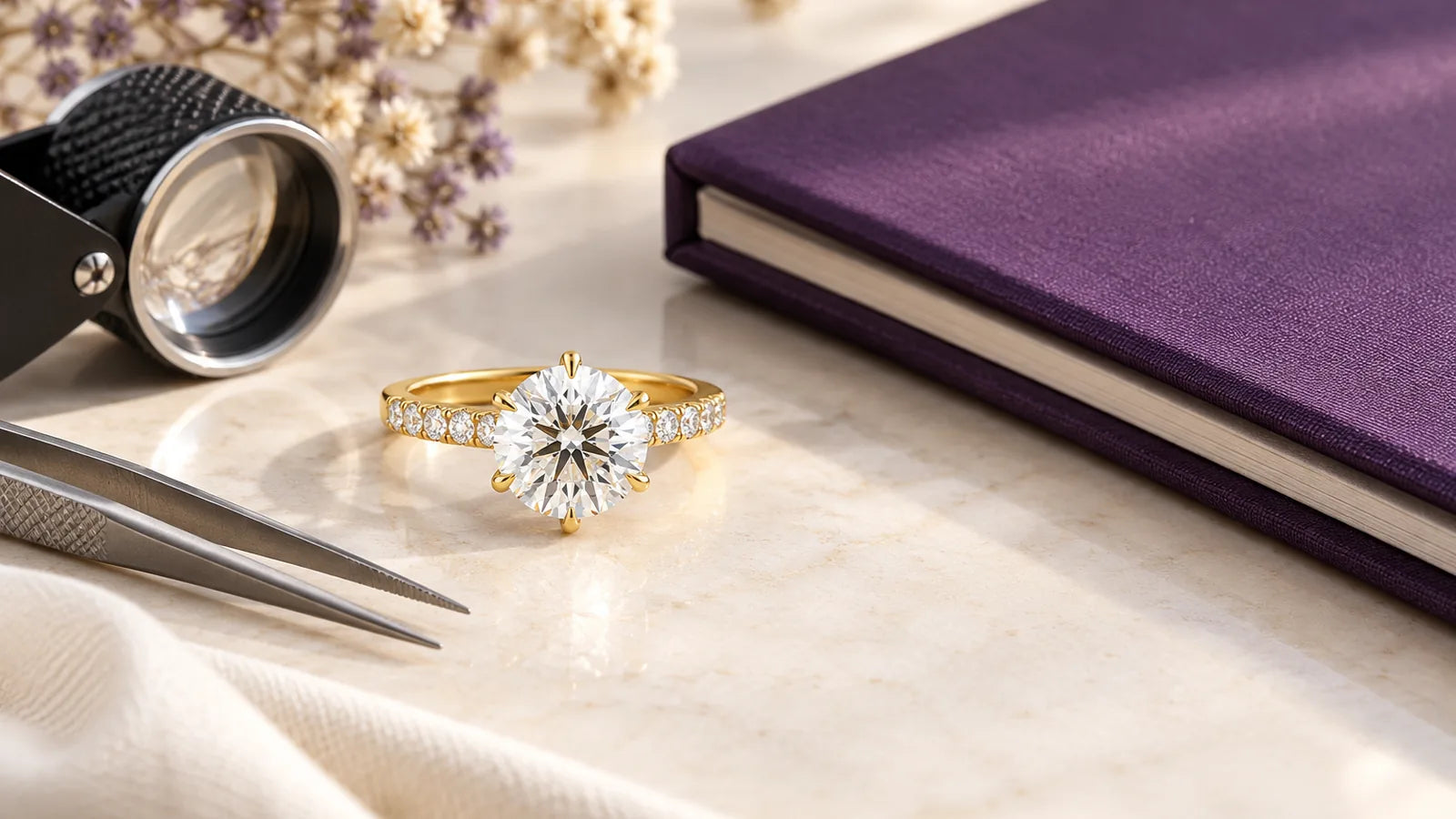
IGI is the International Gemological Institute, an independent gemological laboratory. It examines a diamond and writes down what it finds. The title of a lab-grown report reads Laboratory Grown Diamond Report, and the word “Laboratory Grown” appears in the description. A report describes the stone on the day it was graded. It does not set a price.
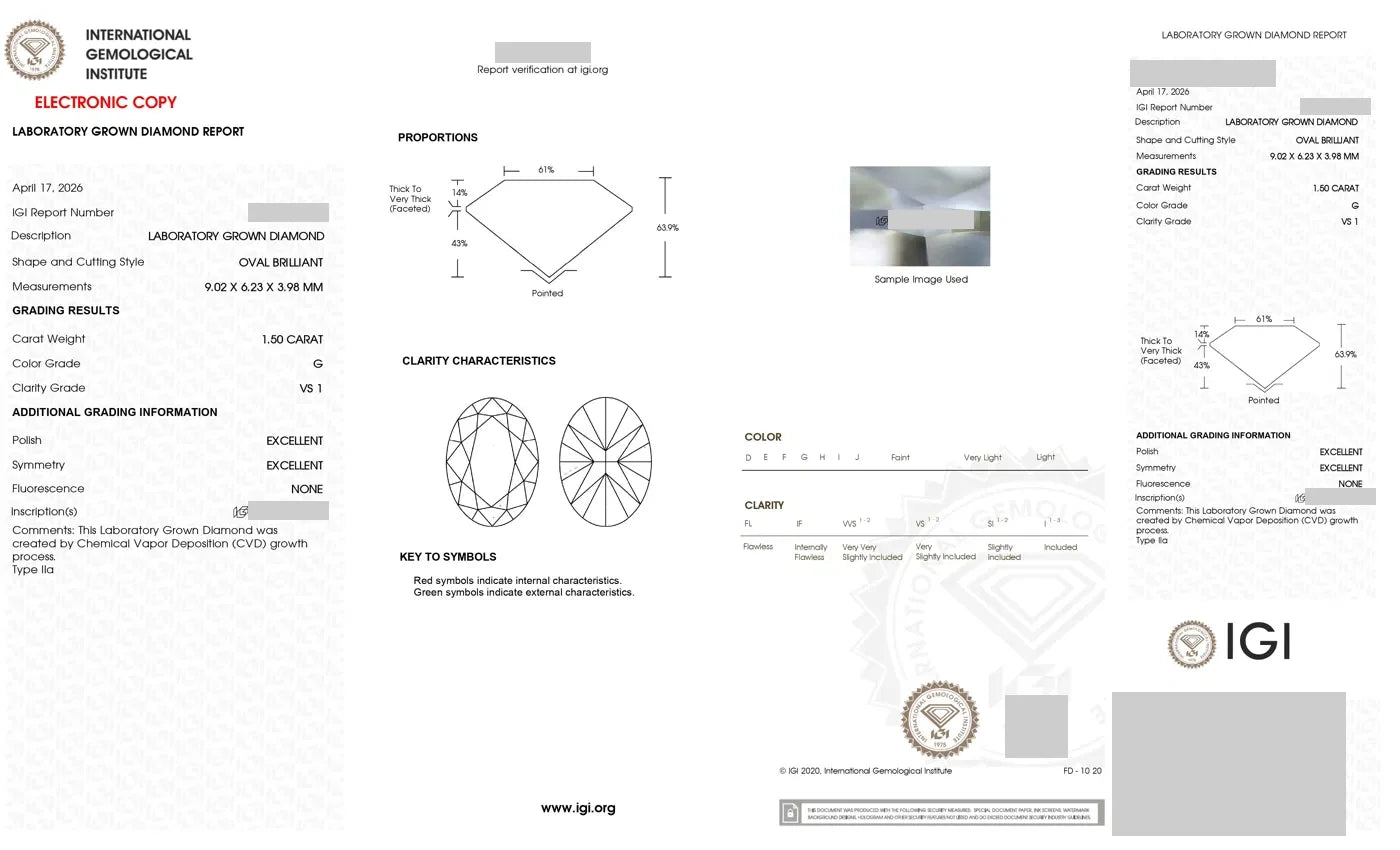
| Line on the report | In this example | What it means |
|---|---|---|
| Report number | Hidden | The unique ID of this report. It starts with LG for lab-grown. |
| Description | Laboratory Grown Diamond | Confirms the stone was grown in a lab. |
| Shape and cutting style | Oval brilliant | The outline and the facet pattern. |
| Measurements | 9.02 x 6.23 x 3.98 mm | Length, width and depth. Carat is weight, not size, so measurements show how big it looks. |
| Carat weight | 1.50 carat | The weight of the stone. |
| Colour grade | G | How colourless the diamond is. The scale on the report starts at D, the most colourless. |
| Clarity grade | VS1 | How many tiny marks the stone has. The scale runs from Flawless (FL) through Internally Flawless (IF), VVS, VS and SI to Included (I). |
| Polish and symmetry | Excellent, Excellent | How well the surface is finished and how even the facets are. |
| Fluorescence | None | Whether the stone glows under ultraviolet light. |
| Inscription(s) | IGI logo and report number | A tiny laser engraving on the girdle (the thin edge) that matches the paper report. |
| Comments | CVD growth process, Type IIa | Names how it was grown. CVD is chemical vapor deposition. Type IIa is a very pure kind of diamond. |
The report also has a proportions diagram (the depth and table percentages), a clarity characteristics map that shows where any small marks are, and a key to symbols: red marks are inside the stone, green marks are on the outside. This oval report lists polish and symmetry, but no single cut grade.
What an IGI report does not tell you
You will see both names. IGI still gives full letter grades for lab-grown diamonds. Since 1 October 2025, GIA has stopped giving D-to-Z colour and clarity grades to new lab-grown diamonds and uses broader “Premium” and “Standard” descriptions instead (GIA announcement). So the two reports look different, and it is not fair to say one is stricter than the other. We use IGI.
Every centre stone comes with an IGI report, and it ships with your ring in the presentation box.
Our return policy asks for the original report. A $150 replacement fee is deducted from a refund if it is missing or damaged, so keep it safe.
They are two ways to grow a diamond in a lab. The report names the method used for your stone.
Yes. It is grown in a lab, not mined, and it is the same carbon crystal as a mined diamond. A report with the words “Laboratory Grown” makes clear which kind you are buying.
Browse engagement rings and toi et moi rings. Related: the 4Cs of diamonds and how to choose the perfect engagement ring.

A plain comparison of ten diamond shapes for engagement rings covering look, sparkle style, corner durability and how big each appears for its weight.
Read Full Article
How to buy an engagement ring when you do not know her ring size and want to keep it a surprise, with a free sizer and free resizing.
Read Full Article
A checklist for buying a lab-grown diamond ring online in the US: certificate, returns, delivery, sizing, timeline and who is behind the shop.
Read Full Article
How long a made-to-order lab-grown engagement ring takes from order to your door, with the real numbers from our shipping policy and what can chang...
Read Full Article
The last safe day to order a made-to-order lab-grown engagement ring for Valentine's Day 2027, worked out step by step from our real production and...
Read Full Article
Lab-grown diamond ring discount: a chance at 5% to 30% off. See the $350 minimum, the limited-time code and the US-only rules.
Read Full Article
Not sure about her ring size or style? An easy guide to lab-grown diamond gifts for Christmas, Hanukkah and Valentine's Day, with sizing, budget, d...
Read Full Article
Planning a Christmas, Hanukkah or New Year's proposal? See the exact 2026 ring order dates, how to find her size secretly, and what to do if time i...
Read Full Article
Shopping for a diamond ring on Black Friday 2026? Learn how to spot fake discounts, check an IGI report, avoid size and delivery mistakes, and see ...
Read Full Article
What is a twist engagement ring set? Learn what a twisted band means, popular twist styles and how to choose a matching set.
Read Full Article
What is a split shank engagement ring? Learn the pros and cons, the best diamond shapes and how to pair a wedding band with it.
Read Full Article
What is a half eternity band, how does it compare with a full eternity band, and how do you pair it with your engagement ring? A simple guide.
Read Full Article
Why are mined diamonds so expensive? Learn what drives their price, the issues behind diamond mining, and how lab-grown diamonds compare.
Read Full Article
Sometimes, moving forward means looking back and in 2026, the jewelry industry is doing exactly that. As the downsides of fast fashion continue to ...
Read Full Article
Anniversaries and milestones are the most meaningful chapters of your love story moments that deserve to be celebrated with something truly special...
Read Full Article
Introduction Finding the perfect ring starts with knowing the right size. Whether you're planning a surprise proposal, buying a wedding band, or tr...
Read Full Article
Where Timeless Beauty Meets Personal Expression, engagement rings in 2026 are changing a lot from what people used to do. Nowadays, engagement ring...
Read Full Article
Not all rings look the same on every finger. Discover how to choose the perfect engagement ring style, diamond cut, and setting to flatter your uni...
Read Full Article
Discover sparkling savings this Black Friday at OctaPearl! Shop luxury diamond rings, earrings, and more with up to 30% off. Don’t miss our exclusi...
Read Full Article
Anniversary Jewelry Gifts Under $500 Thoughtful Picks from Octa Pearl An anniversary is not just a date—it's a celebration of love, commitment,...
Read Full Article
Discover Summer 2025’s hottest jewelry trends in lab-grown diamonds and gold. Explore bold cocktail rings, layered pendants, stackable bracelets an...
Read Full Article
Discover the Best Father's Day jewelry gifts your dad will actually love. From bold rings to custom pieces — perfect for every style and budget.
Read Full Article
Discover what each finger symbolizes when wearing rings. From love to leadership, learn the hidden meanings behind thumb, index, middle, ring, and ...
Read Full Article
Discover the fascinating meaning behind each birthstone and what it reveals about your personality. Find your gemstone’s story now.
Read Full Article
Discover dazzling jewelry gifts under $200! From lab-grown diamond earrings to personalized name necklaces, find elegant, affordable options that m...
Read Full Article
Discover how to pick the perfect cocktail ring to match your style and occasion. From subtle elegance to bold statements, find the right sparkle fo...
Read Full Article
Celebrate Easter with sparkle and style! Explore Octapearl’s elegant collection of lab-grown diamond rings—perfect for gifting or treating yourself...
Read Full Article
Celebrate Her Sparkle: Unique Mother's Day Jewelry Gifts She'll Treasure Forever Mother's Day is the perfect occasion to honor the woman who has gi...
Read Full Article
Learn the essentials of diamond quality with our guide to the 4Cs—Carat, Cut, Color, and Clarity. Discover how these factors determine a diamond’s ...
Read Full Article
Choosing the perfect wedding band doesn’t have to be overwhelming. At OctaPearl, we’ve simplified the process with this concise guide. Explore popu...
Read Full Article
Choosing the perfect engagement ring can be overwhelming. Learn about different ring styles, diamond cuts, metal types, and expert tips to find the...
Read Full Article
Discover unique and unforgettable marriage proposal ideas to create the perfect engagement moment. From romantic getaways to creative surprises, fi...
Read Full Article
The Ultimate Jewelry Styling Tips for Any Occasion Jewelry is a powerful way to enhance your look and express your personality. Whether you’re dres...
Read Full Article
Surprise your mom this Mother’s Day with an exquisite Art Deco ring! Featuring vintage-inspired designs, intricate filigree work, and sparkling gem...
Read Full Article
Difference Between Wedding Bands and Engagement Rings When it comes to celebrating love, engagement rings and wedding bands play a significant rol...
Read Full Article
Discover the perfect diamond promise ring for your partner. Explore our collection of lab-grown diamond rings in 10K, 14K, and 18K gold & plati...
Read Full Article
Celebrate International Women's Day with our stunning Art Deco rings. Explore timeless elegance with beautifully crafted lab-grown diamond rings in...
Read Full Article
St. Patrick’s Day is a time of joy, celebration, and of course, a touch of green! Every year on March 17th, people across the world honor Irish cul...
Read Full Article
Explore the elegance and timeless appeal of Art Deco engagement rings—the perfect choice for a unique proposal. If you’re looking for an engageme...
Read Full Article
Lab-Grown Diamond Jewelry for Self-Gifting? Absolutely! Who says you need a Valentine, a proposal, or even an excuse to shine? In 2025, self-love...
Read Full Article
Discover stunning handmade bridal jewelry, from vintage-inspired elegance to minimalist chic designs. Explore the unique craftsmanship and customiz...
Read Full Article
A three-stone engagement ring is more than just a dazzling piece of jewelry—it’s rich in meaning and symbolism, making it a perfect choice for coup...
Read Full Article
Learn how to properly care for and maintain your jewelry, including lab-grown diamond pieces in gold and platinum. Keep your jewelry sparkling for ...
Read Full Article
Learn about the different types of diamond settings, from prong to invisible, and discover which setting will enhance the brilliance of your diamon...
Read Full Article
Explore the timeless elegance of jewelry metal colors, including yellow gold, white gold, rose gold, and platinum. Learn how each metal suits diffe...
Read Full Article
Learn how to choose the perfect metal for your jewelry. Explore the differences between yellow, white and rose gold and platinum, their advantages,...
Read Full Article
Explore our exclusive collection of Art Deco wedding rings and discover a piece that reflects your one-of-a-kind love story.
Read Full Article
Art Deco wedding bands epitome vintage charm, blending geometric patterns, intricate details, and timeless sophistication. Inspired by the opulent ...
Read Full Article
Vintage rings are often one-of-a-kind or limited edition, making them a special choice for couples looking for something truly unique.
Read Full Article